The Lloyd’s Market
Printable VersionLloyd’s was well known internationally and enjoyed a sound reputation for much of the twentieth century. But, as the world discovered in the 1960s, the Society of Lloyd’s had problems.
Part of Lloyd’s historic mystique … involved its unique organizational structure based on its underwriting members, i.e., Names, and the system that had evolved around this distinct class of investors. Every Name enjoyed near anonymity while participating in a traditionally highly profitable enterprise; and every Name accepted unlimited liability … in each syndicate that he or she joined.
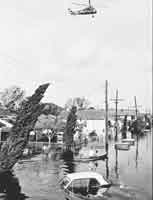
hit southern Florida and then flooded New Orleans in 1965.
… Lloyd’s series of crises actually began in the United States in 1965 with Hurricane Betsy that wreaked havoc on oil rigs and vessels in the Gulf of Mexico. For the first time in decades, the battering caused by Betsy and other hurricanes caused Lloyd’s underwriters to lose money for those consecutive years, from the year before Betsy through 1966.
Although the average loss was modest, it caused a reduction in the number of members for 1966-67. Shock waves rippled through the market. Simultaneously, the value of oil refineries and oil rigs was skyrocketing. More underwriting capacity, not less, was needed for Lloyd’s to sustain its competitive position.
Changes in eligibility for Lloyd’s membership, together with a period of favorable underwriting results, spawned dramatic membership growth during the 1970s. The number of Names almost doubled between 1974 and 1978. When the decade ended, Lloyd’s had nearly 17,000 members. … Unfortunately, many Names joined just in time for a terrible year in 1978. The newcomers represented a broad cross section of the population, rather than the traditional moneyed elite. … (Some) had very limited means, and they met the membership test through bank guarantees based on modest homes.
… During the 1960s and 1970s, while Lloyd’s underwriting capacity was expanding rapidly, the U.S. judicial system was undergoing a major transformation. With courts more often rendering idiosyncratic interpretations of tort law, contract principles became less relevant. This resulted in an avalanche of rulings that held insurers responsible for consequences they often had never intended to insure. Asbestosis, environmental pollution, professional malpractice, and product liability produced billions of dollars of losses.
… If there was a single year after which Lloyd’s would never be the same, it was 1978. From 1978 through 1979, calamitous marine disasters interrupted the underwriting calm. …136 vessels, each with a value exceeding $750,000, were total losses during 1979. Underwriters contended with a rash of losses: scuttlings, marine frauds, piracy in the Mediterranean, and the beginning of the 1990 Iraq-Iran conflict in the Persian Gulf.